More Parents Are Now Opting for International Schools in Malaysia


In recent years, more and more parents are turning to international schools in Malaysia for their children. In 2024 alone, nearly 70,000 children were enrolled in international schools, an 18.2% jump from the previous year, according to the Department of Statistics Malaysia (DOSM).
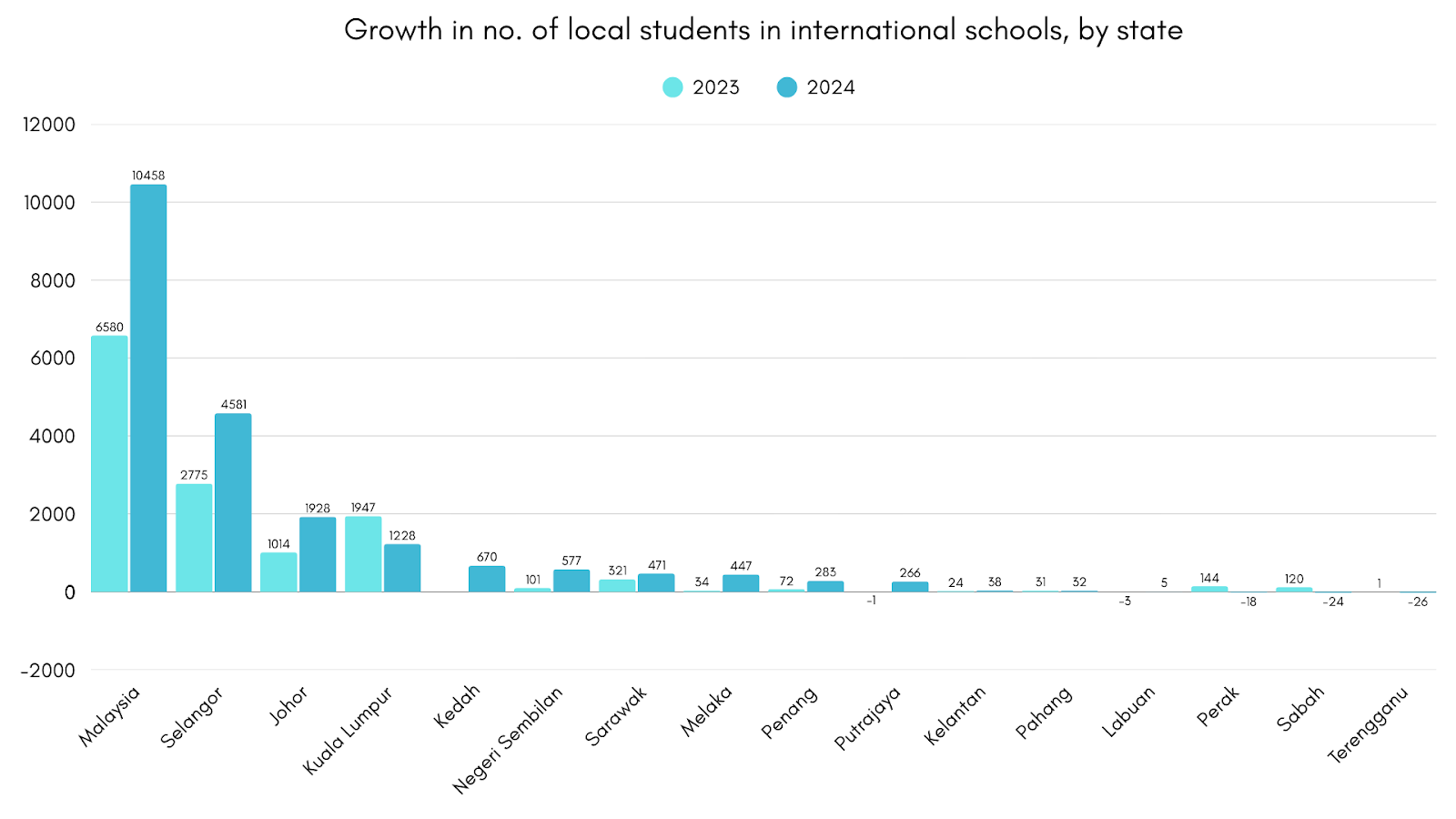
Source: MOE, DOSM
Other private school streams, including special education and academic secondary schools, have also recorded a strong growth.
- Special education schools grew by 32%
- Academic secondary schools grew by 16.7%
- Religious secondary schools grew by 7.2%
- Academic primary schools grew by 5.6%
- Religious primary schools grew by 4.6%
- Chinese private secondary schools grew by 3.3%
Altogether, 216,513 Malaysian children were enrolled in private schools in 2024.
Meanwhile, national schools still educate 4.8 million students , but parents with the means are increasingly exploring other options.
Source: DOSM
But what is driving this shift? And what should parents know as the country prepares for a major 2027 school curriculum reform?
Why Parents Are Choosing Private Schools
Universiti Utara Malaysia School of Education senior lecturer Dr Muhammad Noor Abdul Aziz said the rising demand isn’t just a trend, it’s a long-term pattern.
These parents are attracted to:
- Globally recognised, consistent curricula (especially in international schools)
- Smaller class sizes
- Better facilities and resources
- More flexible, student-centred teaching
- Less pressure from exam-focused learning
- A learning culture that emphasises skills, not just exams.
Many parents feel that private schools offer a calmer, more structured and better-paced environment, especially at the secondary level, where exam stress peaks.
For children with special needs, the availability of immediate therapy and individualised learning in private settings is also a major factor.
Is This a Shift Away from National Schools?
Not at all.
Dr Muhammad Noor explains that this trend reflects stratification rather than rejection.
Families with different financial abilities and educational goals are simply choosing different paths.
He also emphasises that national schools can provide a strong, modern education, but it requires:
- Upgraded facilities
- Improved English proficiency programmes
- Better student support systems
- More teacher training
- A curriculum that includes critical thinking, digital skills and global competencies.
“The upcoming 2027 school curriculum has the potential to boost confidence in national schools, but parents will want to see real improvements before they start taking their children out of private schools,” he said.
Will the 2027 Curriculum Reform Change Things?
National Union of the Teaching Profession secretary-general Fouzi Singon agrees that the new curriculum aims to inspire more confidence among teachers, students and parents.
"Although the curriculum will be based on research and extensive engagement, theoretical improvements made to fix old weaknesses may still take time for the community to accept and understand," he said.
He points out that despite resource differences, Malaysia’s 10,000 national schools continue to produce high achievers, supported by dedicated teachers.
"This track record reflects the commitment, capability, and impact of the national education system,” he said.
Education Minister Fadhlina Sidek has stated that national schools are not inferior and the ministry continues to improve facilities and teaching quality.
In 2025, nationwide roadshows will be launched to gather input for the 2027 school curriculum reform, aiming to make national education more relevant and future-ready.
How Malaysia Compares Regionally
Malaysia’s international school enrolment is high compared to some neighbours:
- Thailand: 77,734 students
- Singapore: 21,200 students
And globally, Asia continues to dominate the international school market, housing 58% of the world’s international schools.
Malaysia’s private school sector continues to grow steadily, especially among urban, middle-income families.
What This Means for Parents Making School Decisions
If you’re deciding between national and private schooling, consider:
- Your child’s learning style
- Your budget and long-term financial commitment
- Your expectations for class size, support, and environment
- Whether your child needs specialised learning support
- How much you value international exposure or English-medium learning
Ultimately, the best school is the one that fits your child’s learning style, needs and long-term goals.
Recent Articles
- Which Curriculum Can You Get at an International School Under RM30,000? (2026 Guide)
- International School Fees in Malaysia: Budget vs Mid-Tier vs Premium - What Are You Paying For?
- Hidden Fees at Budget International Schools in Malaysia: What Tuition Does Not Cover
- Is Preschool Compulsory in Malaysia? What the 13MP Proposes
- International Schools in Klang Valley With Tuition Fees Below RM30,000 in 2026